

Understanding Combined FUT and FUE Hair Transplantation:
Hair transplantation today involves several techniques and approaches. FUT (Follicular Unit Transplantation) and FUE (Follicular Unit Excision) are the two main techniques that have been used for many years. In some cases, however, a doctor may consider using both techniques together, a treatment approach known as Combined FUT & FUE
A common question is:
What is Combined FUT & FUE, and why would two techniques be used for the same hair transplant procedure?
The answer is that combining FUT and FUE does not mean that both techniques are necessary for everyone. It is an option that a doctor may consider for patients who require a large number of grafts, have limitations in their Donor Area, or need a carefully planned approach to graft utilization
The important point is that choosing a technique should not begin with the question, “Which technique is the best?” It should begin with:
“Which technique is most appropriate for this particular patient’s goals?”
This article explains what Combined FUT & FUE means, how it works, its advantages and limitations, who may be suitable candidates, what should be considered before the procedure, and how to care for the scalp afterward
What Is Combined FUT & FUE?
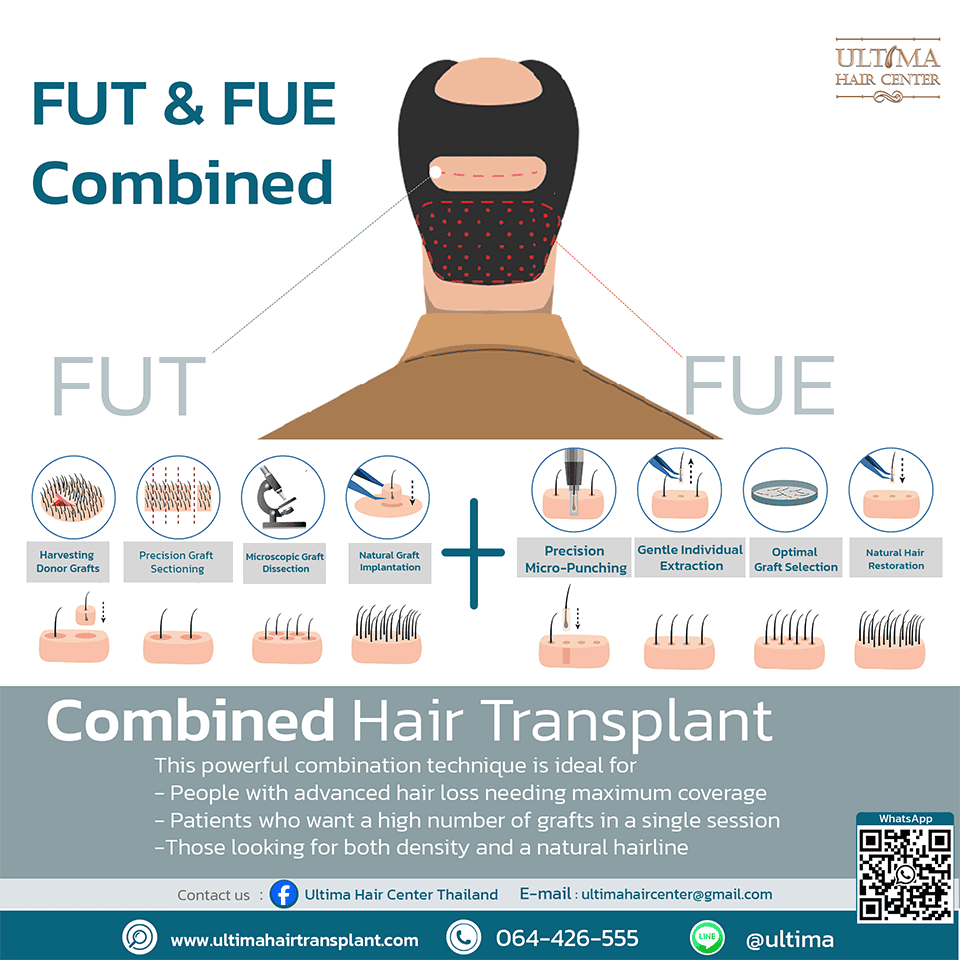
Combined FUT & FUE refers to using both FUT and FUE techniques to harvest hair grafts as part of the same treatment plan
In general:
FUT involves removing a strip of scalp from the Donor Area and then separating the tissue into individual hair grafts using an appropriate graft preparation process
FUE involves using a small punch instrument to extract individual follicular units from the Donor Area
By combining the two techniques, the doctor can plan graft harvesting using both approaches in order to obtain an appropriate number of grafts based on the individual patient’s situation
Why Combine FUT and FUE?
The main considerations are the number of grafts required and the limitations of the Donor Area
Some patients have extensive areas of hair loss, such as:
- A receding frontal hairline
- A broad forehead
- Thinning in the mid-scalp
- Hair loss affecting several areas at the same time
If increased density is required across multiple areas, a relatively large number of grafts may be needed
In some cases, using only one technique may not be the most appropriate approach. The doctor may therefore consider harvesting grafts using both FUT and FUE to provide greater flexibility in graft planning and allocation
Understanding FUT First
FUT stands for Follicular Unit Transplantation
The principle involves removing a strip of scalp from the Donor Area. The tissue is then processed and separated into individual follicular unit grafts
One advantage of FUT is that, in certain cases, it can provide a relatively large number of grafts from a selected area without requiring individual extraction of each follicular unit across the Donor Area
However, FUT creates a linear scar in the Donor Area. Therefore, factors such as the following need to be considered:
- Hairstyle and preferred hair length
- Scalp laxity
- Previous surgical history
- Individual scar characteristics
- Patient preferences
What Is FUE?
FUE stands for Follicular Unit Excision
It is a technique in which individual follicular units are harvested from the Donor Area using a small punch instrument to separate the grafts from the surrounding tissue
The most obvious difference from FUT is that FUE does not require a strip of scalp to be removed
The extraction sites therefore appear as multiple small points in the Donor Area
However, FUE does not mean that there are “no wounds”. Small wounds are created at the extraction sites, and their number and distribution depend on the number of grafts harvested and the harvesting technique used
How Is Combined FUT & FUE Different From FUE Alone?
With FUE alone, all grafts are harvested using the FUE technique
With Combined FUT & FUE, the harvesting process is planned using both FUT and FUE
For example, a doctor may consider using FUT to harvest a certain number of grafts and then use FUE to harvest additional grafts when appropriate
The two techniques do not have to be used in equal proportions
In some patients, FUT may provide the majority of the grafts while FUE serves as a supplementary approach. In other cases, the plan may be different
There is no fixed formula
Advantages of Combined FUT & FUE Hair Transplantation
1. Greater flexibility in planning the number of grafts in certain cases
One important advantage is having two options for harvesting grafts
For patients with extensive hair loss who require a large number of grafts, the doctor may consider using both FUT and FUE to provide greater flexibility in treatment planning
However, this should not be interpreted as meaning that combining the two techniques allows an unlimited number of grafts to be harvested
The Donor Area still has limitations
2. Planned use of the Donor Area
The number of available hair grafts in the Donor Area is limited
Therefore, good planning does not simply mean removing as many grafts as possible. It should also consider how the available grafts can be used appropriately
Combining FUT and FUE may be one option for managing the resources available in the Donor Area in selected patients
3. May be suitable for some patients who require a large number of grafts
Patients with extensive areas of hair loss may require a substantial number of grafts to cover the desired areas
Combined FUT & FUE may therefore be considered by a doctor when the assessment indicates that it is appropriate
However, the number of grafts must remain consistent with the quality of the Donor Area and the long-term treatment plan
4. Allows the characteristics of both techniques to be considered together
FUT and FUE have different characteristics
Using them together allows the doctor to develop a graft-harvesting plan based on the patient’s individual limitations and goals
This is one reason why careful planning by the doctor is important
Limitations of Combined FUT & FUE
Although combining the two techniques can have advantages, it does not mean that it is better than using a single technique for every patient
1. There will be a FUT scar and FUE extraction sites
This is an important difference to understand before making a decision
FUT creates a linear scar
FUE creates small extraction sites
Patients should therefore understand the expected pattern of scarring and the necessary aftercare before undergoing the procedure
2. Not everyone is suitable for both techniques
Some patients may be better suited to FUE alone, while others may be better suited to FUT
Some patients may not be suitable for hair transplantation at that particular time at all
Therefore, Combined FUT & FUE should be the result of an appropriate medical assessment rather than simply a decision to obtain the largest possible number of grafts
Who May Be Suitable for Combined FUT & FUE?
Suitability depends on the individual patient, but doctors may consider this approach for patients such as:
Patients with extensive areas of hair loss
For example, patients with thinning affecting both the frontal hairline and mid-scalp
Patients who require a large number of grafts
Provided that the Donor Area can support an appropriate harvesting plan
Patients with a suitable Donor Area
The density and quality of the available grafts should be evaluated first
Patients who want a systematic long-term hair restoration plan
Rather than focusing only on improving one particular area
Who May Not Be Suitable?
Examples may include:
- Patients with a very thin Donor Area
- Patients with low hair density
- Patients with certain scalp conditions requiring further assessment
- Patients with existing surgical scars that require additional evaluation
- Patients expecting a number of grafts beyond the available donor resources
- Patients who have not yet received an appropriate diagnosis for their hair loss
This is why a thorough assessment before treatment is important
The Most Important Consideration: The Donor Area
When discussing Combined FUT & FUE, one important question should not be overlooked:
“How many grafts do we actually have available?”
rather than simply asking:
“How many grafts can we remove?”
These are two different questions because excessive harvesting can cause the Donor Area to appear thinner
The doctor should therefore assess:
- Number of available grafts
- Hair density
- Hair caliber
- Graft characteristics
- Safe donor harvesting areas
- Previous graft harvesting
Combined FUT & FUE Requires Long-Term Planning
This is particularly important for patients with genetic hair loss, as hair loss may continue to progress in the future
If too many grafts are used from the Donor Area during the first procedure, fewer resources may remain available for future treatment
Therefore, the doctor should consider:
How many grafts are needed today?
and
How many grafts might be needed in the future?
A good hair transplant plan should therefore not focus only on solving today’s problem
Can Combined FUT & FUE Produce Natural-Looking Hair?
The technique itself is not the only factor determining whether the transplanted hair will look natural
The result depends on multiple factors, including:
- Hairline design
- Graft selection
- Number of hairs per graft
- Density
- Direction
- Hair angle
- Graft distribution
- Donor Area quality
- Postoperative care
Therefore, it should not be assumed that Combined FUT & FUE will produce a more natural-looking result than FUE or FUT in every patient
Hairline Design Remains a Key Part of the Procedure
Even when an appropriate graft-harvesting technique is used, an unsuitable hairline design can affect the overall result
Hairline design should take into account:
- Age
- Facial structure
- Forehead characteristics
- Hair characteristics
- Number of available grafts
- Desired density
- Potential future hair loss
The goal should be a hairline that is appropriate for the individual patient and contributes to an overall natural-looking appearance
More Grafts Do Not Necessarily Mean a Better Result
Some people may think:
“If 4,000 grafts are used, the result must be better than with 2,500 grafts”
However, this cannot be determined simply by the number of grafts
If the area requiring transplantation is relatively small, a large number of grafts may not be necessary
Conversely, if the area is extensive, too few grafts may result in density that does not meet expectations
The number of grafts should therefore be appropriate for the treatment area and the patient’s goals
Combined FUT & FUE for Patients Who Have Had a Previous Hair Transplant
Patients who have undergone a previous hair transplant require particularly careful assessment because they may have limitations such as:
- Previously depleted Donor Area
- Existing FUT scar
- Previous FUE extraction sites
- Limited remaining grafts
- An unsuitable existing hairline
- A need to correct the previous result
In such cases, a doctor may consider Combined FUT & FUE as one possible option, but the situation must be assessed individually
Is Combined FUT & FUE Hair Transplant Painful?
The level of discomfort during the procedure depends on local anesthesia and individual factors
After the procedure, some patients may experience:
- Tightness in the Donor Area
- Swelling
- Irritation
- Pain or discomfort around the wound
The FUT area may feel tight because of the linear wound
The doctor will provide appropriate postoperative instructions and medications based on the individual patient’s situation
How Should You Prepare for Combined FUT & FUE?
Before the procedure, inform your doctor about:
- Existing medical conditions
- Medications you are taking
- Supplements
- Drug allergies
- Previous surgeries
- Previous hair transplant procedures
- History of hair loss
- Previous hair-loss treatments
You should follow your doctor’s instructions regarding preparation for the procedure carefully
Do not stop prescribed medications on your own
How Should You Care for Your Hair After Combined FUT & FUE?
Postoperative care should follow your doctor’s individual instructions, but generally, attention should be given to the following:
1. Protect the transplanted grafts
Avoid scratching, picking, or rubbing the transplanted area
2. Care for the Donor Area
Particular attention should be paid to the FUT wound, following the doctor’s wound-care instructions
3. Wash your hair as instructed
Do not immediately return to your usual hair-washing routine without first following your doctor’s instructions
4. Avoid impact or trauma
Be particularly careful around the transplanted area during the early postoperative period
5. Temporarily avoid certain activities
This may include strenuous exercise for a period recommended by your doctor
6. Attend follow-up appointments
Follow-up allows the doctor to assess recovery and hair growth
Will the Transplanted Hair Grow Immediately?
Transplanted hair follows its own growth cycle
During the early period, the transplanted hair may shed before entering a new growth phase
Therefore, the result should not be evaluated too early. Follow-up at appropriate intervals is important when assessing the development of the transplanted hair
Why Is Choosing the Doctor Important for Combined FUT & FUE?
This approach requires careful planning because more than one harvesting technique is involved
The doctor needs to evaluate:
Donor Area → Number of grafts → Harvesting techniques → Recipient Area → Graft allocation → Long-term plan
Patients should therefore choose a doctor who can clearly explain the reasoning behind the selected approach
It should not simply be:
“This case requires Combined FUT & FUE”
The doctor should be able to explain:
“Why is this approach appropriate for you, and what are its advantages and limitations?”
Why Consider Hair Transplantation With an ABHRS-Certified Physician?
For people researching hair transplantation with an ABHRS-certified physician, ABHRS certification is one factor that may be considered when choosing a hair restoration physician
However, certification should not be the only consideration. It is also useful to evaluate:
- Actual results
- Treatment-planning approach
- Donor Area assessment
- Techniques used by the physician
- Communication with patients
- Postoperative follow-up
This can be particularly important in cases requiring more than one technique
Hair Transplantation With Dr. Ming and Individualized Treatment Planning
For those searching for hair transplantation with Dr. Ming, an important consideration is whether the treatment plan is tailored to the individual patient
Combined FUT & FUE is not suitable for everyone
The physician should consider:
- Whether a large number of grafts are actually necessary
- Whether the Donor Area has sufficient resources
- Whether FUT is appropriate
- Whether FUE is appropriate
- Whether both techniques should be used
- Whether there is a long-term plan for future hair loss
Dr. Ming Personally Responds to Patient Messages Before Treatment
Another aspect that Ultima Hair Center places importance on is direct communication with patients. Dr. Ming personally responds to patient messages, allowing patients to discuss their hair loss concerns and initial questions directly
This is particularly useful for questions about:
- FUE
- FUT
- Combined FUT & FUE
- Number of grafts
- Hairline design
- Donor Area
- Second hair transplant procedures
- Corrective hair transplantation
Discussing these issues in advance can help patients understand what they should consider before making a decision
After the procedure, patients can also communicate regarding postoperative care and follow-up
Quality-Focused Hair Transplantation Is Not About Maximizing the Number of Grafts
The concept of quality-focused hair transplantation should not mean trying to use the largest possible number of grafts
Rather, it should mean:
Using the available grafts appropriately according to each patient’s problem and goals
The Donor Area has limitations
Harvesting too many grafts may affect the density of the Donor Area
On the other hand, using too few grafts may fail to provide the desired improvement in density
Therefore, the key is appropriate graft allocation
7 Questions to Ask Before Choosing Combined FUT & FUE
If you are considering this approach, it is useful to ask your doctor at least the following:
1. Why is Combined FUT & FUE appropriate for me?
2. Could I achieve my goals with FUE alone?
3. Would FUT alone be sufficient?
4. Approximately how many grafts do I need?
5. Will I have enough donor resources for the future?
6. Where will the FUT scar be, and how should it be managed?
7. What result should I realistically expect?
These questions can help patients understand the reasoning behind the treatment rather than choosing a technique based solely on its name
Frequently Asked Questions About Combined FUT & FUE
What is Combined FUT & FUE?
It is an approach that uses both FUT and FUE to harvest hair grafts, allowing the number and use of grafts to be planned according to each individual patient
Is Combined FUT & FUE better than FUE alone?
It cannot be said to be better in every case. The appropriate approach depends on the condition of the Donor Area, the number of grafts required, and each patient’s goals
Who may be suitable for Combined FUT & FUE?
It may be considered for some patients with extensive hair loss who require a large number of grafts and have a Donor Area that can support an appropriate harvesting plan. However, a doctor should assess suitability first
Does Combined FUT & FUE leave scars?
Yes. FUT produces a linear scar, while FUE produces small extraction sites where the grafts are harvested
Will Combined FUT & FUE produce natural-looking hair?
The result depends on multiple factors, including hairline design, graft selection, direction, angle, density, and graft placement. It does not depend on the name of the technique alone
How many grafts are needed?
There is no fixed number. The required number depends on the treatment area, Donor Area quality, available density, and the patient’s goals
Can everyone undergo Combined FUT & FUE?
No. The choice of technique must be individualized. Some patients may be better suited to FUE or FUT alone, while others may not yet be suitable candidates for hair transplantation
Conclusion: What Is Combined FUT & FUE?
Combined FUT & FUE is a hair transplantation approach that combines FUT and FUE to provide additional options for harvesting and allocating hair grafts in selected cases, particularly for patients who require a large number of grafts or have extensive areas of hair loss
However, not everyone needs both techniques
The decision between FUE, FUT, and Combined FUT & FUE should take into account:
- Cause of hair loss
- Degree of hair loss
- Quality and quantity of the Donor Area
- Number of grafts required
- Hair characteristics
- Hairstyle
- Age
- Potential future hair loss
- Patient expectations
Therefore, for anyone looking for quality-focused hair transplantation, the priority should be an individualized treatment plan rather than choosing a technique simply because it is marketed as the “best”
For those searching for hair transplantation with Dr. Ming, the process can begin with an initial discussion and assessment before making a decision. Dr. Ming personally responds to patient messages, allowing patients to ask directly about FUE, FUT, and Combined FUT & FUE
For those considering hair transplantation with an ABHRS-certified physician, it is advisable to consider the physician’s qualifications, actual results, Donor Area planning, hairline design, selected techniques, and postoperative care together
At Ultima Hair Center, the focus is on selecting an approach that is appropriate for each individual patient rather than simply trying to maximize the number of grafts, because in hair transplantation, every available graft is valuable and should be carefully planned and utilized from the first procedure
